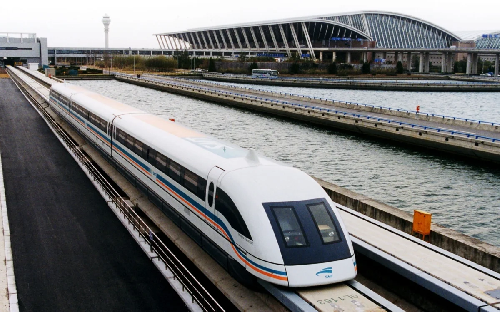
China has reportedly set a new benchmark in high-speed transportation after an experimental maglev train accelerated from 0 to 497.1mph (800km/h) in just 5.3 seconds, breaking its own acceleration world record.
The record-breaking test took place on a one-kilometre test track at the Donghu laboratory in Hubei province, highlighting the rapid development of China’s magnetic-levitation technology. Unlike conventional trains, maglev vehicles use powerful magnetic forces to lift the train slightly above the track. With virtually no wheel-to-rail contact, rolling friction is eliminated, while electromagnetic propulsion drives the vehicle forward at extraordinary speeds.
During the latest test, the experimental train reportedly reached 497.1mph (800km/h) from a standstill in only 5.3 seconds. Just as impressive was its braking performance. After reaching its maximum speed, the vehicle was brought to a stop within approximately 200 metres, demonstrating the high-performance braking and control systems required for such extreme acceleration tests. The achievement is particularly notable because it reportedly marks the third time in six months that the experimental maglev has broken its own acceleration record.
The experimental system first attracted widespread attention in June 2025, when it reportedly accelerated to 650km/h (approximately 404mph) in seven seconds, establishing a new record. Engineers subsequently pushed the technology further, with later tests reaching approximately 434mph and then 495mph before the latest run raised the benchmark to 497.1mph. Each test has allowed researchers to examine the system’s propulsion, stability, braking and control capabilities under increasingly demanding conditions.
Maglev—or magnetic levitation—technology allows a vehicle to travel without relying on conventional wheels running along rails. Magnetic forces suspend the vehicle above its guideway, substantially reducing mechanical friction. Electromagnetic systems along the track then propel and control the train. The technology has long been considered one of the most promising approaches to ultra-high-speed ground transportation, although engineering complexity, infrastructure costs and safety requirements remain significant considerations for large-scale commercial deployment.
China has invested heavily in maglev research and already operates commercial maglev technology. Experimental projects such as the Hubei test system are exploring what could eventually be possible at speeds far beyond those of conventional high-speed rail. With the latest test reportedly approaching 500mph in barely five seconds, China’s experimental maglev programme has demonstrated another striking milestone in the development of ultra-high-speed ground transportation.